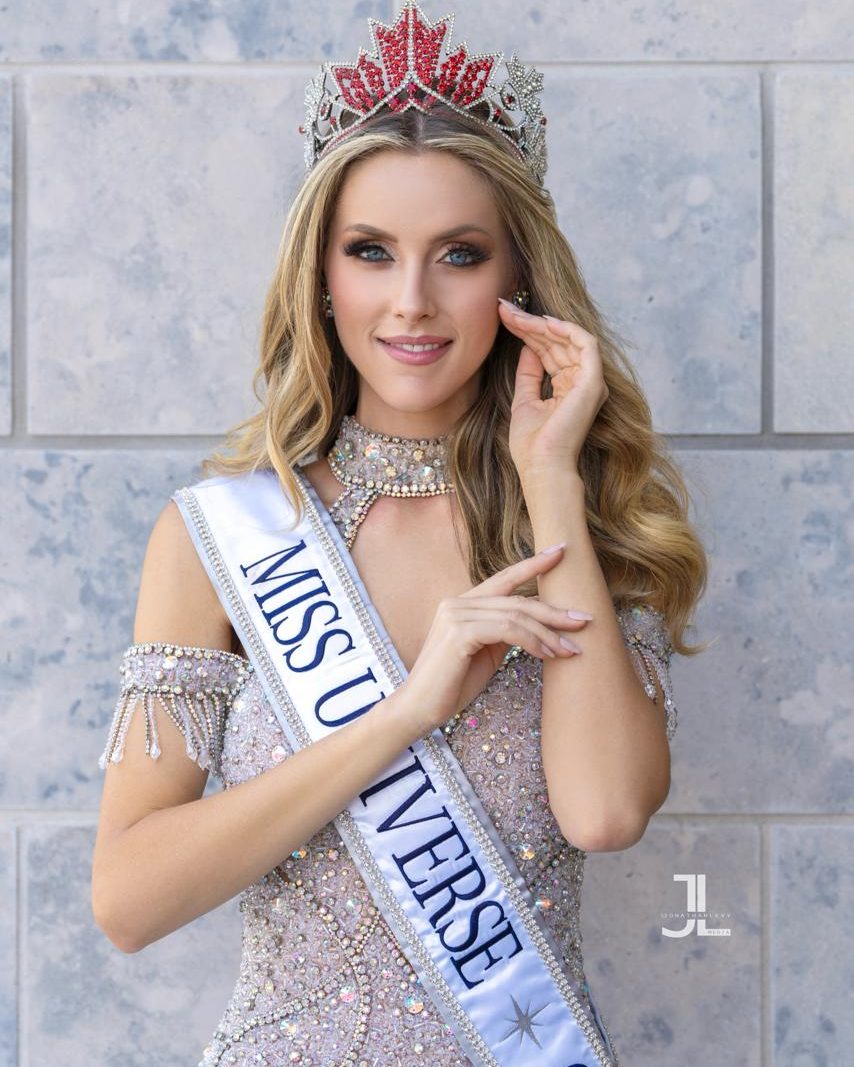
Being the Miss Universe Canada photographer for three consecutive years, 2023, 2024, and 2025, is the kind of credential that opens conversations, but the credential itself is the least interesting part of the story. What I actually want to talk about is what those three years did to my craft, my approach to portraiture, and my understanding of what it means to photograph people under pressure, at scale, with no room for error.
In all three years, I produced the official Queen headshots, the formal portraits that represent the Miss Universe Canada queen publicly. My image of the queen became the official thumbnail used across the organization's channels. That's not something you get handed because you showed up with a camera. You earn it by producing work that the organization trusts with the face of their brand.
This is the story behind that work.
How It Started: Getting the Call
I didn't pursue Miss Universe Canada. The introduction came through the network that forms when you've spent years doing serious editorial and portrait work in Toronto. By 2023, I had been a founding contributor and Creative Director at Spencer Magazine since 2019, had been working as the special events coverage photographer for Rémy Martin and Louis XIII, and had built a body of portrait work that spoke for itself. The organization was looking for someone with a specific combination of capabilities: technical precision under difficult shooting conditions, the ability to work with a large number of subjects in a single day while making each image feel individual, and the editorial sensibility to produce photographs that looked like magazine work, not event snapshots. The first conversation made it clear that this wasn't a standard event photography engagement. The production scale of a major national pageant is genuinely complex. You're working within a live production that has its own timeline, its own creative direction, and its own stakeholders. The photography has to happen within that structure, not around it. What the organization needed, and what I could offer, was editorial experience. Traditional event photography skills, where you document what happens and hope the light cooperates, weren't what they were after. They needed someone who could shape images, direct subjects with confidence, and produce a visual record that served the brand of the organization as much as it documented the event. Saying yes to the first year in 2023 meant committing to something I knew would raise the standard of everything in my portfolio. That was the point.
What Shooting a National Pageant Actually Looks Like
The preparation starts well before event day. In the weeks leading up to the pageant, there are contestant portrait sessions, wardrobe and styling coverage, and location scouting for the specific environments that will be used during the production. By the time the event itself arrives, I already know the contestants, I know the spaces, and I know the program. Event day itself is controlled chaos, which is a kind description. A live national pageant runs on a production schedule that doesn't flex for photography. You know when the lighting changes. You know when the program moves from the opening walk to the interview segment to the evening gown competition. Every shot has to happen within those windows, and the windows don't wait. Working in environments you don't control is the defining challenge of event photography. Mixed lighting, stage washes, practical fixtures, natural light bleeding in from windows, creates technical problems that have to be solved in real time, without stopping the show. Fast movement, fast transitions, no second chances. The technical foundation has to be automatic so that the creative decisions are the only ones you're consciously making. The official Queen headshots are a distinct assignment within the larger event. These portraits represent the winning contestant publicly. They appear across the organization's channels, they become the face of Miss Universe Canada for the year. The image I produced in 2023 became their official queen thumbnail. That level of responsibility shapes how you approach every frame. There is no casual. There is no "let's see how it comes out." Every technical and creative decision is deliberate because the result is going to represent a person and an organization for twelve months. The images I'm most proud of from Miss Universe Canada aren't the competition shots. They're the quiet moments: a contestant laughing off-camera between segments, a genuine expression caught when the subject didn't know the camera was on them, a portrait taken in the twenty seconds between a scheduled shot and the next cue. Those moments tell the real story, and getting them requires being present, not just technically ready.
The Craft Behind the Portraits
Photographing fifty-plus subjects in a single day while keeping each portrait feeling individual and intentional is a discipline that has to be built deliberately. The risk is assembly-line photography, where everyone gets the same light, the same angle, and the same direction, and the resulting gallery is technically acceptable but visually flat. My approach at Miss Universe Canada was to treat each contestant's portrait as its own brief. Some subjects photograph best with direct eye contact and minimal direction. Others come alive when you give them something to do, a gesture, a movement, a change in posture. Reading a subject quickly and adjusting is the core skill that separates portrait photography from documentation. I don't stand behind the camera and wait for it to happen. I'm actively directing, actively watching, actively responding to what I see in the frame. The lighting design in pageant photography has to work across a wide range of subjects. Different skin tones, different facial structures, different coloring, all of them require attention. The goal is not a uniform look but a consistently high level of quality that reads as cohesive when the full gallery is viewed together. The official Queen headshots demanded an additional level of care. These are not just portrait sessions. They're the creation of an official image that represents a person in their most public moment. The approach I took in 2023, 2024, and 2025 was consistent: editorial lighting, clean composition, and retouching that presents the subject as themselves on their best day. Not transformation. Not filtration. The real person, in the best possible light, with every technical decision in service of that goal. On post-processing: my philosophy is editorial retouching, not transformation. The contestants look like themselves in my photographs, on their best day, in the best light, with their best expression. What retouching isn't for is altering faces, erasing structural features, or producing images that look like they came through a filter. I hold this line firmly, and the organization understood and respected it from the start.
What Three Years Has Taught Me About Portrait Photography
Three years of consecutive high-stakes event work teaches you things that can't be learned in a studio. The most important is consistency under pressure: showing up at the same technical and creative level, year after year, regardless of what the day throws at you. The second year is harder than the first, because the standard is already set. The third year is harder than the second, for the same reason. By 2025, the third year, my role had expanded. I was the official event photographer, not just for the portraits but for the full production. That expansion didn't happen by accident. It happened because the organization had three years of evidence that the work would be there, every time, at the level they needed. Building trust with subjects is the skill that unlocks everything else. Contestants who felt comfortable with me opened up in ways that produced extraordinary images. That trust isn't manufactured through pleasantries. It comes from being prepared, being calm, being clear about what you're asking for, and demonstrating through the first few frames that you know what you're doing. Subjects feel when a photographer is confident. It relaxes them. The value of this portfolio work for BYJonathanLevy Media extends beyond the credential itself. Clients in Toronto's corporate and creative markets look at Miss Universe Canada and understand that I've operated at a national scale, under real production pressure, with consistent results. That's what three years of this work has built. It has also shaped how I think about every individual portrait session. When you have stood behind a camera with fifty subjects to photograph and a production schedule counting down around you, you develop an acute instinct for reading people quickly, making fast decisions about light and composition, and delivering work that holds up at a high volume. Those are skills that transfer directly into executive portraits, brand shoots, and editorial work, and they only come from being tested at this level.